Machines
4
Music
Affordable Products for the Audiophile Designed and Engineered in England
...it's a noise absorber
For the long version of the development story, scroll down - you may already have read it elsewhere...
In the sense that it has mass, it is a weight. However, whereas most record weights are... erm... record weights, there is far more under the skin here. It employs tuned dampers which couple to the record by three point contacts. These behave like miniature and very sensitive shock absorbers, which are able to absorb low frequency noise from the record. This could be rumble, infrasonic noise in the record itself, or acoustic / mechanical feedback. Thus, it is able to clean up low frequency information, making drum hits crisper, bass string resonance easier to perceive etc.
This isn't just word salad, this is backed up by real world objective testing on my miniature shaker table, and confirmed in use via a client's analysis using a test record and Digital Signal Processing to isolate the range of interest. WRT subjective assessment, the designer MUST be wary of expectation bias, so I was happy that both sets of measurement confirmed my view that this device really does do what I designed it to do!
The Back Story
25 Years ago, the course of my work in defence required me to make rotating hard drives work in the harsh vibration environment of a hovering helicopter, as I was losing vital data on the systems I was testing. This led me to try all sorts of COTS vibration damping - all of which was rejected as it was designed for much heavier items such as equipment racks. This meant I had to go a little off piste and started playing with much softer polymers. The upshot was (car suspension designers know all about this!) that there is a relationship between spring rate, suspended mass, and damping frequency, and it would be possible for me to attenuate the issue frequencies (rotor frequency as its known) by careful matching of these. I knew the rotor frequency, I could change the mass within reason (bolting the hard drives to a plate to which I could add or remove mass) and I could change the damper softness between a few commonly available materials. Scroll forward 25 years and I can now tune a printable polyurethane via hardness, density and internal structure. This means that I can make 'weights' of different masses with similar frequency of operation.
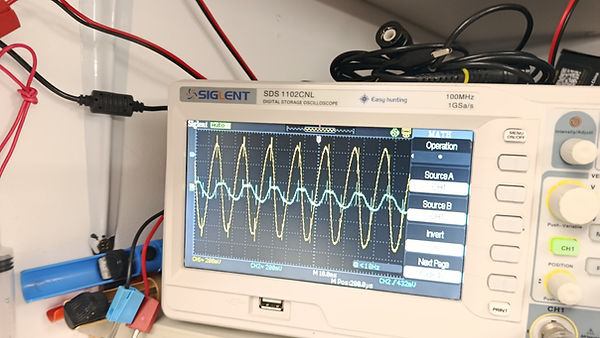
This is a sample from testing of a 400g device. The yellow trace is the input amplitude to the shaker table. The blue trace is the measurement of the device itself. The difference between the two is the attenuation. This is in millivolts (the raw output from the shaker sensors) but it equates to around 12 dB of loss through the absorber. If you understand the dB scale, this is a significant amount!
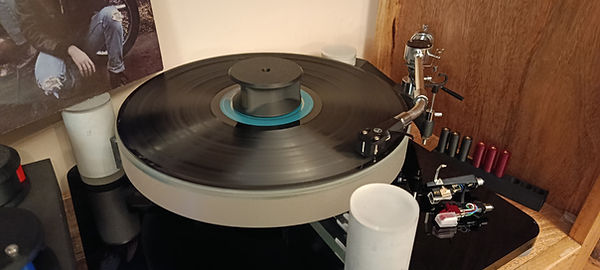
Some subjective listening to the absorber in the shaker test above. Denon DL103 here, due to the expected low frequency improvements. This type is £149 inclusive of UK postage
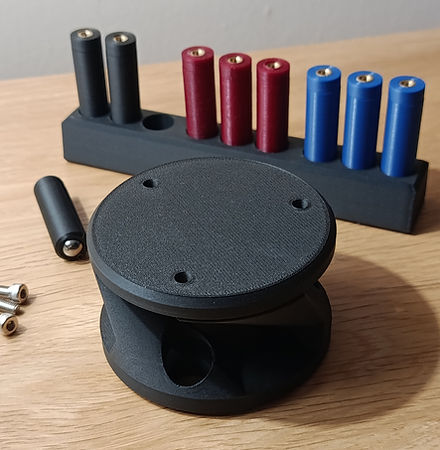
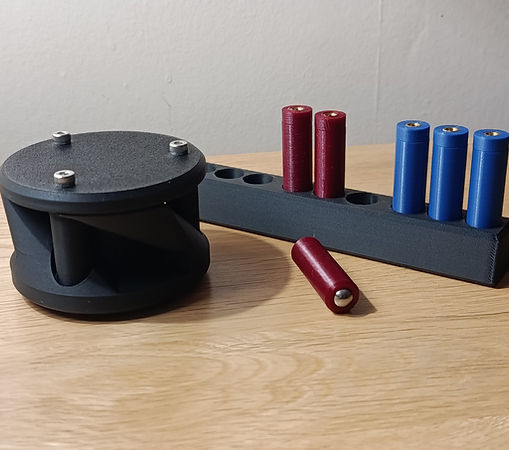
The latest development is a version with user replaceable damping cartridges (ultra-soft, soft and medium) for those who would like to tune the damping to their own preference. Cartridges are swapped using a 4mm allen key (supplied) in seconds. This version is £199 including UK postage